
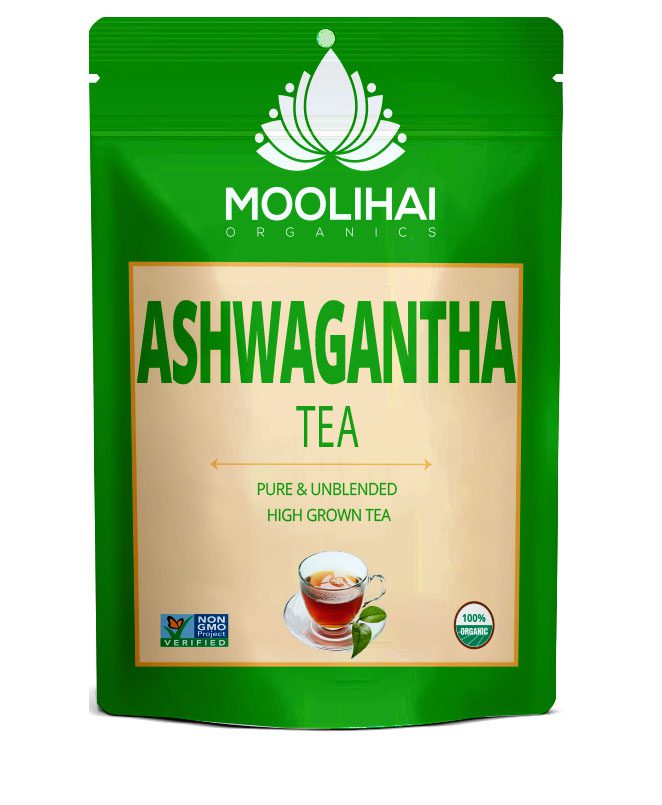
Natural Ashwagandha Tea | Withania somnifera | Stress Relief Tea | Gluten Free | Non-GMO – 100 gm (3.5 oz)
19.00$
- Weight: 100 gm (3.5 oz)
- Origin: India
Ashwagandha tea is a powder of natural Withania somnifera root with no added sugar, preservatives, natural or artificial flavors, and artificial sweeteners. Sip on to feel the soul!
Withania Somnifera · Root Powder Tea · 100g (3.5 oz) · Caffeine Free · Gluten Free
Ashwagandha Root Tea — Ayurveda’s Answer to Modern Stress
Ashwagandha literally means “smell of the horse” in Sanskrit — named for the raw, earthy odour of its root and the belief that consuming it grants the vitality of a stallion. Known as Amukkara (அமுக்கரா) in Tamil and classified as a Rasayana (rejuvenative tonic) in Ayurveda, this root has been prescribed for over 3,000 years to rebuild the body after illness, calm an overworked mind, and restore the kind of deep energy that coffee can only imitate. The active compounds — withanolides — are adaptogens, meaning they help the body resist and recover from physical and mental stress rather than masking it. This tea is pure ground ashwagandha root, nothing else added. The taste is earthy and bitter. Most people sweeten it with honey and lemon, or blend it with warm milk and cardamom for a traditional nightcap. 100g pack, enough for roughly 100 cups.
100% Pure Root Powder
Caffeine Free · Non-GMO
No Sugar · No Preservatives
Ships via DHL / UPS
What Makes Ashwagandha Different from Every Other Tea
Most teas give you antioxidants or vitamins. Ashwagandha gives you something rarer: adaptogenic activity. Adaptogens are a specific class of herbs that regulate the hypothalamic-pituitary-adrenal (HPA) axis — the body’s central stress response system. When you’re under chronic stress, your cortisol stays elevated for too long, disrupting sleep, immunity, digestion, mood, and hormonal balance. Withanolides (the active steroidal lactones in ashwagandha root) modulate cortisol production — bringing it down when it’s too high and supporting it when the body is depleted. The effect isn’t stimulation or sedation. It’s regulation. Your body finds its baseline again. That’s why ashwagandha has historically been given both to anxious insomniacs (to sleep) and to exhausted labourers (to recover energy). Same root, different outcomes, because the mechanism is adaptive rather than one-directional.
What a Daily Cup Supports
Stress & Cortisol
Lowers elevated cortisol, calms the HPA axis
Sleep Quality
Promotes natural sleep onset without sedation
Sustained Energy
Reduces fatigue without caffeine or stimulants
Physical Endurance
Supports stamina, recovery, and VO2 max
Immunity
Increases white blood cell activity
Focus & Memory
Supports cognitive function under stress
Inflammation
Withanolides reduce systemic inflammation
Hormonal Balance
Supports thyroid and reproductive hormones
Who Benefits Most from Ashwagandha Tea
People Under Chronic Work Stress
Clinical trials have measured cortisol levels in adults taking ashwagandha versus placebo over 60 days. The ashwagandha groups consistently showed significant reductions in serum cortisol — in some studies by nearly 30%. Participants also reported lower perceived stress, less anxiety, and better sleep. If you’re in a demanding job, running a business, managing long hours, or dealing with ongoing mental pressure, daily ashwagandha tea targets the exact physiological mechanism (chronic HPA axis activation) that turns temporary stress into burnout. The effect builds gradually over 2–4 weeks of daily use.
People Who Struggle with Sleep
Ashwagandha root contains triethylene glycol, a compound that promotes sleep onset. But the sleep benefit goes beyond a single compound. By lowering cortisol and calming the nervous system, ashwagandha addresses the most common cause of poor sleep in modern adults: a mind that won’t shut down at bedtime. Drinking ashwagandha tea in the evening — particularly blended with warm milk and a pinch of cardamom, the traditional Ayurvedic method — creates a calming pre-sleep ritual that works both pharmacologically (withanolides, triethylene glycol) and behaviourally (the ritual itself signals the body to wind down). Clinical data shows improvement in both sleep onset latency and sleep quality.
Athletes and Physically Active People
Multiple studies have found that ashwagandha supplementation improves VO2 max (aerobic capacity), increases muscular strength and recovery speed, and reduces exercise-induced muscle damage. One trial showed a significant increase in muscle mass and reduction in body fat percentage over 8 weeks in resistance-trained men. The mechanism ties back to cortisol — elevated cortisol is catabolic (breaks down muscle), and by keeping cortisol in check, ashwagandha creates a more anabolic (muscle-building) hormonal environment. For anyone training hard, whether running, lifting, or playing sport, ashwagandha supports better recovery and better output over time.
Men and Women Managing Hormonal Health
Ashwagandha supports thyroid function — studies have shown improvement in TSH, T3, and T4 levels in patients with subclinical hypothyroidism. For men, ashwagandha has demonstrated increases in testosterone and improvements in sperm quality across multiple clinical trials, likely through its cortisol-lowering mechanism (cortisol suppresses testosterone production). For women, ashwagandha may help regulate menstrual cycles disrupted by stress and support fertility. If you are on thyroid medication, consult your endocrinologist before adding ashwagandha — it may alter your required dose.
How to Make Ashwagandha Tea
Boil & Simmer
Boil 1 cup of water in a saucepan. Add 1 teaspoon of ashwagandha tea powder. Put the lid on and let it simmer on low heat for 10–15 minutes. This longer steeping time matters — ashwagandha root is dense and woody, and the withanolides need extended heat exposure to fully extract into the water. The liquid will turn a pale brown colour.
Strain & Flavour
Filter through a fine sieve into your cup. The taste is earthy, somewhat bitter, and woody — not sweet or pleasant on its own. Honey takes the edge off. A squeeze of lemon adds brightness. For a richer experience, brew with warm milk instead of water and add a pinch of cardamom — this is the traditional Indian preparation that has been served at bedtime for centuries. Ginger and cinnamon also pair well, adding warmth and helping mask the bitterness. Moolihai’s Marthandam Honey and Masala Chai spices complement this brew naturally.
When to Drink
Ashwagandha works differently depending on timing. In the morning, it provides calm, sustained energy — ideal as a coffee replacement for people who want alertness without jitteriness or a caffeine crash. In the evening, it becomes a sleep preparation tool — the cortisol-lowering and nervous-system-calming effects help the body transition into rest mode. You can drink it at either time, or both. If you’re new to ashwagandha, start with one cup in the evening for the first week to see how your body responds, then add a morning cup if you want the daytime benefits too. At 1 teaspoon per cup, 100g provides roughly 100 servings.
Making It Taste Good
Ashwagandha root is bitter. No sugarcoating that. But the right additions turn it into something genuinely enjoyable.
Honey + Lemon
The simplest fix — sweet, bright, drinkable
Warm Milk + Cardamom
Traditional nightcap — creamy, soothing, aromatic
Ginger + Cinnamon
Warming winter version — masks bitterness with spice
Buttermilk
South Indian traditional method — tangy, cooling
Hazelnut Milk
Nutty richness — works as a latte-style drink
Cherry Juice
Bold, fruity — hides the bitterness completely
What You’re Getting
100g (3.5 oz)
~100 cups at 1 tsp per serving
Root Powder
Withania somnifera root, ground
India
Origin
Caffeine Free
Morning or evening use
Nothing Added
No sugar, preservatives, or flavouring
Gluten Free
Non-GMO
10–15 Min Steep
Simmer with lid on for full extraction
$19.00
~$0.19 per cup
Ships Worldwide
USA
5–7 Days
FREE OVER $99
UK
5–7 Days
FREE OVER $99
Canada
5–7 Days
FREE OVER $99
Ships worldwide via DHL/UPS. Shipping info →
Common Questions
This product is 100g of pure ashwagandha root powder — single ingredient, maximum potency, loose powder that you simmer for 10–15 minutes. The Turmeric Ashwagandha Herbal Tea ($13.99) is a blended tea in tea bags combining ashwagandha with turmeric and other herbs. It’s milder, more palatable, and quicker to prepare (just steep the bag). If you want the strongest ashwagandha dose per cup — for serious stress management, sleep support, or athletic recovery — this pure root powder delivers more. If you prefer convenience, gentler taste, and the added anti-inflammatory benefit of turmeric, the blended tea bags are the easier daily option. Some customers use both: pure ashwagandha at night for sleep, the blended tea during the day for lighter maintenance.
Not in the way you might expect. Ashwagandha doesn’t contain caffeine and won’t give you the immediate alertness spike that coffee does. What it provides instead is a gradual, building sense of energy and clarity that comes from lowered cortisol, better sleep quality, and reduced mental fatigue — the opposite of borrowing energy from tomorrow, which is what caffeine does. People who switch from coffee to ashwagandha tea often report that the first week feels flat (because they’re used to the caffeine hit), but by week two or three, they notice steadier energy throughout the day without the afternoon crash. If you’re trying to quit coffee, consider tapering gradually while adding ashwagandha rather than switching cold turkey.
Ashwagandha is slow medicine, not fast relief. Sleep improvements often come first — many people notice they fall asleep more easily within 1–2 weeks of nightly use. Stress and anxiety reductions typically become apparent at 2–4 weeks, which aligns with the timeframe in clinical trials measuring cortisol levels. Physical performance and endurance benefits take longer — 6–8 weeks of consistent daily use in the studies that measured VO2 max and muscle strength. Hormonal effects (testosterone, thyroid) are the slowest, requiring 8–12 weeks. Throughout all of this, daily consistency matters more than dose. Skipping days interrupts the adaptive process.
This requires a conversation with your endocrinologist before you start. Ashwagandha has been shown to increase thyroid hormone levels (T3 and T4) and may alter TSH — which means it could change the dose of levothyroxine or other thyroid medication you need. For people with hypothyroidism not on medication, ashwagandha may provide supportive benefit. For people with hyperthyroidism (overactive thyroid) or Graves’ disease, ashwagandha could worsen the condition and should be avoided. For those on thyroid medication, the interaction is clinically significant enough that your doctor needs to know. Don’t add ashwagandha quietly and assume it’s “just a tea.”
No. Ashwagandha should be avoided during pregnancy. It has known abortifacient properties at higher doses — traditional Ayurvedic texts explicitly contraindicate it for pregnant women. This is one of the clearest and most well-documented contraindications in herbal medicine. Do not consume ashwagandha tea, supplements, or root in any form during pregnancy. After delivery, ashwagandha is traditionally used to help new mothers recover strength and manage postpartum fatigue, but discuss timing with your doctor, especially if breastfeeding. The restriction applies specifically to pregnancy, not to women in general.
Unlikely. Ashwagandha is not a sedative — it doesn’t knock you out the way melatonin or valerian root might. It works by lowering cortisol and calming the nervous system, which promotes natural sleep when your body is ready for it (evening) and calm alertness when it isn’t (morning). Most people who drink ashwagandha tea in the morning report feeling focused and steady, not sleepy. The sleep benefit kicks in primarily when you’re already winding down for the night. That said, everyone’s sensitivity differs. If you’re completely new to adaptogens, try your first cup in the evening to gauge how your body responds before adding a morning cup.
*Disclaimer: Ashwagandha tea is a traditional Ayurvedic herbal preparation made from Withania somnifera root. Benefits described are based on traditional knowledge and published clinical research on ashwagandha. Not intended to diagnose, treat, cure, or prevent any disease. Contraindicated during pregnancy — ashwagandha has documented abortifacient properties. May interact with thyroid medications, sedatives, immunosuppressants, and blood sugar-lowering drugs. People with autoimmune conditions (lupus, rheumatoid arthritis, Hashimoto’s, multiple sclerosis) should consult their doctor before use, as ashwagandha may stimulate immune activity. Not recommended for people with hyperthyroidism or Graves’ disease. Discontinue if you experience stomach upset, diarrhoea, or unusual symptoms. Individual results vary.
| Weight | .1 kg |
|---|
Be the first to review “Natural Ashwagandha Tea | Withania somnifera | Stress Relief Tea | Gluten Free | Non-GMO – 100 gm (3.5 oz)”
You must be logged in to post a review.
Related products


Reviews
There are no reviews yet.